
2026-04-26, 1800 UTC
Region 4419 with X-flares and CMEs moves away. At least three active regions with flare and solar storm (CME) potential remain.
Synoptics

26.4.2026
2026-04-26, 1800 UTC – Regions 4420, 4424 and 4425 in the north with flare and CME potential, with region 4420 just in the Earth-strike zone. Region 4223 shows signs of decay. The remaining regions are small and simple.
We are currently under the influence of the positively polarised coronal holes CH45 and CH47 with slightly increased solar wind speed at about 450 km/s and a predominantly northward interplanetary magnetic field (IMF) with little geomagnetic impact.
Weak influence from the negatively polarised coronal hole CH48- from 29 April.
Region 4419 and X-class flares
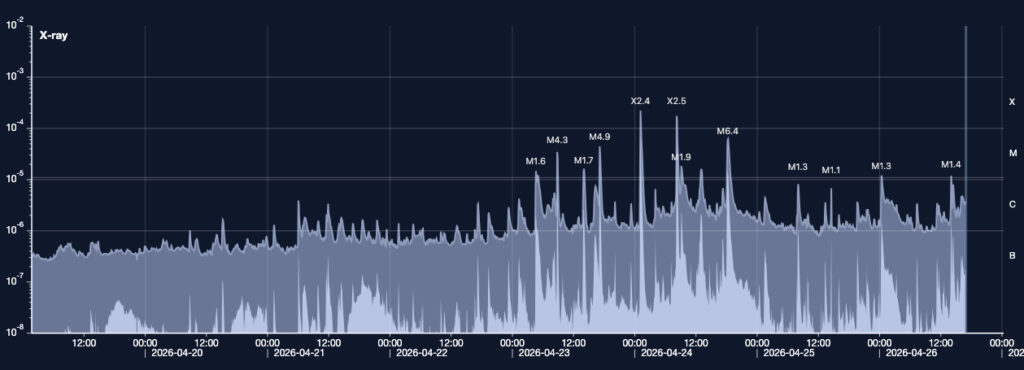
19 April – 26 April 2026
Increase in flare activity since 23 April, two X-class flares and stronger M-class flares, especially from region 4419, which has now already disappeared behind the western limb.
Most recently, 4419 was clearly in the decay stage with decreasing complexity, but just before reaching the western limb of the Sun, a new small active region appeared directly west of the large leader spot with rapid evolution. This destabilised the whole system and led to strong outbursts with large amounts of plasma, M- and two X-class flares (X2.4 and X2.5).
GOES SUVI 304, SDO AIA 131
Due to the location on the western limb, there were no earth-directed coronal mass ejections.
SDO AIA 131, 171, 304
Region 4420 – complex and elongated
Sunspot group 4420 is currently the largest region with high complexity and correspondingly high flare potential.
M1.2 flare on early 23 April: Filament eruption with CME and supra-arcade downflows (SADs). Parts of this coronal mass ejection (CMEs) have probably already reached us and caused some turbulence in the solar wind.
There are more CMEs on the way, some with slight grazing potential – but nothing worth writing about in detail.
It makes sense to keep an eye on solar activity at the moment. To be continued in this article or in a new one – depending on the relevance of future events
More updates always on X or bluesky
⚜️