
Update 2026-10-09; 1800 UTC
Several CMEs are on their way, roughly heading towards Earth, but they have all been deflected northwards and are likely only to graze the Earth. Aurora may be visible from 10 October, particularly in the higher mid-latitudes. From around 11 October, a large trans-equatorial hole extending far southwards will begin to affect the Earth. Synergistic effects with the CMEs are possible.
CME = coronal mass ejection = solar storm
Synoptic
Sunspot Group 4549
It is complex; it is still evolving and, from time to time, emits flares and releases CMEs. It will likely continue to do so, but as it moves away from the Earth-strike zone, Earth-directed CMEs from it are becoming less likely.
Region 4549 in the SDO HMI magnetogram and SDO HMI continuum
High-speed stream
The coronal hole in the south and east is causing the CMEs to be strongly deflected towards the north-west; the high-speed streams can even be spotted in the coronagraphs.
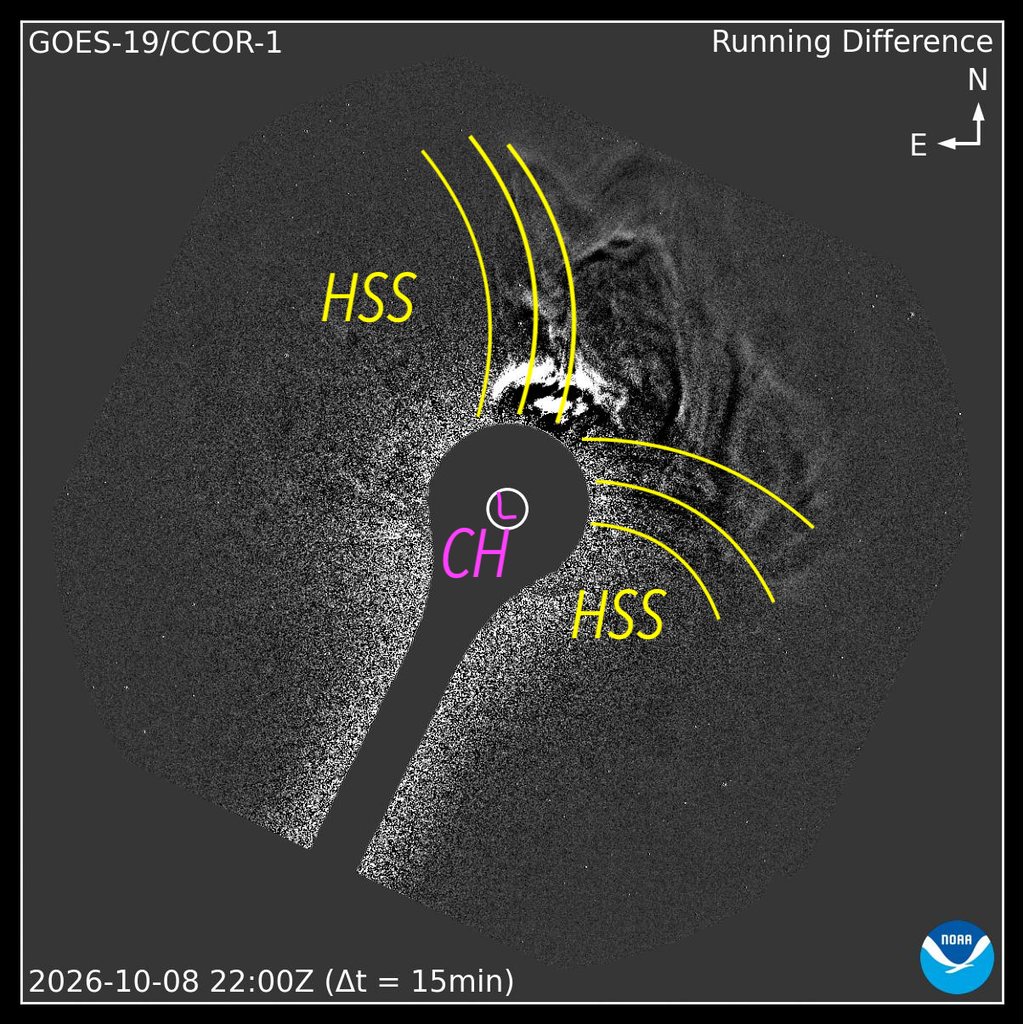

Solar wind speeds of over 700 km/s are possible from 12 October onwards; however, the stream is negatively polarised, which is unfavourable for Aurora at this time of year.
CME 1 – 2026-10-06 (M1.4 flare, M1.8 flare)
As discussed in the previous article:

☞ www.youtube.com/watch?v=PDhIs2WfZKc&t=799s
CME 2 – 2026-10-07 (C6.7 flare)
On 7 October, there was another eruption, accompanied by a rather unremarkable CME heading north-west.
It will probably be overtaken by the next CME.
CME 3 – 2026-10-08 (M6.8 flare, filament eruption)
A moderate M6.8 flare with Type II and Type IV radio bursts. A small, very dense core filament is initially catapulted towards the north-east, followed by another towards the north/north-west. Later, a large filament erupts in the south-east, appearing in the coronagraph as a CME heading north. The coronal hole blows them all away from Earth.
Corona
Radio emissions
There’s a lot going on across the entire radio spectrum – a great deal of energy is being released here


Type III and Type II

Type II and Type IV

Type IV

Type III, Type II

Unspecified bursts

Type IV Burst
All data from the Owens Valley Solar Array https://ovsa.njit.edu/
Predictions
SWPC

SWPC Enlil

SWPC Enlil
The Space Weather Prediction Centre in Boulder, Colorado, has simulated three CMEs from 6 October, 7 October and 8 October, travelling at 571 km/s, 499 km/s and 912 km/s respectively. The last CME will catch up with the one in the middle. A first wave will reach us on 9 October, and a second on 11 October. The high-speed stream is still relatively far away at that point in SWPC’s Enlil model. That probably isn’t the case. I reckon its stream interaction region will also be affecting us from 11 October onwards.
SWPC has issued a G2 (MODERATE STORM) watch for 9 October and a G1 (MINOR STORM) watch for 11 October.
HUXt

HUXt, using NASA analyses and BRAVDA background solar wind data, also shows two peaks in solar wind speed; here, the transition into the high-speed stream is simulated more accurately, albeit significantly later, which probably means it is not entirely accurate either. It is interesting to note that NASA estimates the CME of 8 October to be significantly slower than SWPC (500 km/s vs. 900 km/s).
Conclusion
As always, anything is possible: from almost nothing to a surprisingly strong, prolonged impact. The arrival of the stream interaction region is relatively certain, but the exact time of its arrival is uncertain.
Updates
2026-10-10, 1700z – Strong Impact 2026-10-10; 14:30 UTC

2026-10-10; 17:00 UTC – Magnetic field partly above 40 nT; Bz initially mainly to the north, recently turned negative (south) at around -20 nT, high velocity now at 700 km/s, density initially above 100 particles/ccm; if Bz remains negative, there is a good chance of widespread aurora in Central Europe, perhaps even visible to the naked eye – this mainly affects the northern (poleward) horizon, but if the situation persists, the auroral oval could also drift very far towards the equator.
Disruptions to GPS and radio communications, particularly at lower frequencies, are to be expected.
2026-10-10, 1800z – Aurora in Central Europe
Green proton arc and red rays, with a green aurora oval arc behind; 1750 UTC

2026-10-10; 1750 UTC, 48°N GMLAT

2026-10-10; 1750 UTC, 48°N GMLAT

https://amtsberg.panomax.com?t=2026-10-10+19-50-00&r=6&z=100&tl=0

2026-10-10; 1800 UTC, 48°N GMLAT

2026-10-10; 1800 UTC, 48°N GMLAT

2026-10-10, 1800z
Reduce entropy. Grow. Become love.
𑁍